PRODUCT STRATEGY / AI PROTOTYPING / CONCEPT VALIDATION / 0→1
Prototypes that turned ideas into funded products
Turning complex enterprise ideas into testable product experiences helped stakeholders validate direction faster and move four new initiatives forward with Oliver Wyman.
ROLE
Product design lead
Led rapid prototyping, AI-assisted design workflows, and stakeholder alignment across 4-6 product initiatives. Translated consulting hypotheses into interactive, high-fidelity prototypes that non-technical decision-makers could evaluate and commit to.
CLIENT
Marsh: Oliver Wyman, Mercer
Global consulting leaders serving enterprise clients across financial services, healthcare, and insurance sectors. Engaged at the intersection of strategy consulting and product development.
FOCUS
Enterprise product validation
Validating bold product concepts before engineering investment — including an enterprise-internal startup hub designed to bring startup-level agility into large-scale corporate environments.
MY PROJECT IMPACT / KEY OUTCOMES
My AI-assisted rapid prototyping work with Oliver Wyman accelerated decision-making and played a key role in converting early-stage ideas into signed business.
COMMERCIAL IMPACT
4 new project wins within 12 months
Led AI-assisted rapid prototyping initiatives that directly contributed to 4 new project approvals within 12 months, each launching a cross-functional team of 10 developers and designers. Secured new enterprise contracts and expanded company delivery capacity by 40 team members.
INNOVATION IMPACT
Startup Hub Within Enterprise
Created high-fidelity prototypes that gave global consulting leaders the confidence to invest in bold product innovations — including an internal startup hub designed to bring startup-level agility into the enterprise. Early concept validation reduced costly development mistakes before engineering began.
AI-NATIVE· DECISION INTELLIGENCE · DATA VISUALIZATION · ENTERPRISE SAAS · 0→1
Challenge
Insurance specialists depended on highly complex Excel models that were difficult to learn, maintain, and scale across teams.
Product Vision
Create an enterprise platform that simplifies scenario modeling through intuitive workflows, reusable templates, interactive visualizations, and guided user experiences.
Business Value
Reduce manual effort, improve collaboration, accelerate decision-making, and establish a scalable digital foundation for future AI-powered capabilities.
WORKFLOW EVOLUTION
Inside the prototyping workflow
Business Brief
Structured Prompt
AI-generated UI
Design Review
Refinement Prompt
Interactive Prototype
Stakeholder Validation
Developer Handoff
01. PRODUCT CONTEXT
You are a Lead Product Designer helping create an enterprise SaaS application.
Product: {{Product Name}}
Industry: {{Insurance / Healthcare / Finance / etc.}}
Primary users: {{Claims Managers, Analysts, Underwriters…}}
Business goal: {{What business problem should this product solve?}}
02. UX REQUIREMENTS
Prioritize: task completion • decision making • enterprise scalability
Generate: 1. Page structure 2. Component hierarchy 3. Interaction flow
4. Recommended UX improvements 5. Edge cases
EXAMPLE / OLIVER WYMAN
Design an enterprise dashboard for insurance portfolio analysis.
Users: Portfolio Managers, Actuaries, Executives.
Goal: Help users identify profitability trends, compare reinsurers, and investigate claim performance.
Include KPI cards, Sankey diagram, filters, AI assistant, data table, and drill-down interactions. Generate desktop-first responsive layouts. Show loading, empty, and error states. Use an enterprise design system with reusable components. Explain interaction logic and recommend usability improvements.

Dynamic Scenario Generation
Claims Ratio
Yearly Claim Status
Add Scenario
AVERAGE PREMIUM
$318.02
↗ 5.3%
TOTAL CLAIMS, YTD
$9,410,576
UP 2%
WATCH
Loss ratio rising
42%
Portfolio Risk Signals
LOSS RATIO
72.4%
EXPOSURE INDEX
64 / 100
CLAIM FREQUENCY
1.8×
Generate Scenario
ENTERPRISE UX / SCENARIO BUILDER / REUSABLE VISUALIZATION CARDS
Building interfaces that help experts make confident decisions
Insurance analysts don't need more charts, they need clear answers.
The experience was designed around the decisions users make every day, surfacing the right metrics, contextual insights, and recommended actions at the right moment.
A modular layout made the product scalable while preserving consistency across future features.
AI-ASSISTED ENTERPRISE INNOVATION
From complex ideas to testable enterprise products
I developed a scalable prototyping process that translated business requirements into interactive concepts using AI-assisted workflows. These prototypes enabled faster client feedback, earlier validation of product assumptions, and more confident investment decisions before development.
The approach also made it possible to explore multiple product directions in parallel without committing engineering resources too early.
The result was a more efficient discovery process that strengthened collaboration between consulting, design, engineering, and enterprise clients.

DISCOVERY & STRATEGY
Understanding the operational challenges before redesigning the experience
Before proposing solutions, we partnered with business stakeholders, consultants, and end users to understand how risk teams actually worked. Research focused on uncovering workflow bottlenecks, decision-making patterns, and opportunities to modernize without disrupting trusted processes.
01 / PRODUCT COMPLEXITY
Feature-rich, hard to navigate.
Multiple modules made the platform demanding for both new and infrequent users.
02 / FRICTION
Critical decisions required too many manual steps.
Users relied on multiple dashboards, spreadsheets, and repetitive filtering before reaching actionable insights.
03 / EXPLORATION
Deeper analysis lived outside the product.
Frequent exports revealed a need for clearer in-product filtering, comparison, and insight.
04 / CONTINUITY
Modernize without disrupting work.
A phased rollout had to preserve trusted functionality while improving the end-to-end experience.
RISK MODEL CONSTRUCTOR
Turning spreadsheet logic into intuitive model design
We transformed manual, error-prone Excel workflows into a visual model builder that helps risk teams create, adapt, and compare models with confidence.
Drag & drop model builder
Pre-built components
Version control & governance
Collaborative by design

1
Select Risk Types
Choose from a library of predefined risk categories.
→
2
Drag & Drop Components
Add financial vehicles and arrange the model structure.
→
3
Configure & Define
Set allocations, percentages,
and assumptions for each item.
→
4
Validate & Review
Built-in checks ensure logic integrity and completeness.
→
5
Save & Collaborate
Version, share, and reuse the model across the organization.
GUIDED MODEL-BUILDING EXPERIENCE
Making complex risk modeling visual, guided, and collaborative
SELECT • CONFIGURE • VALIDATE

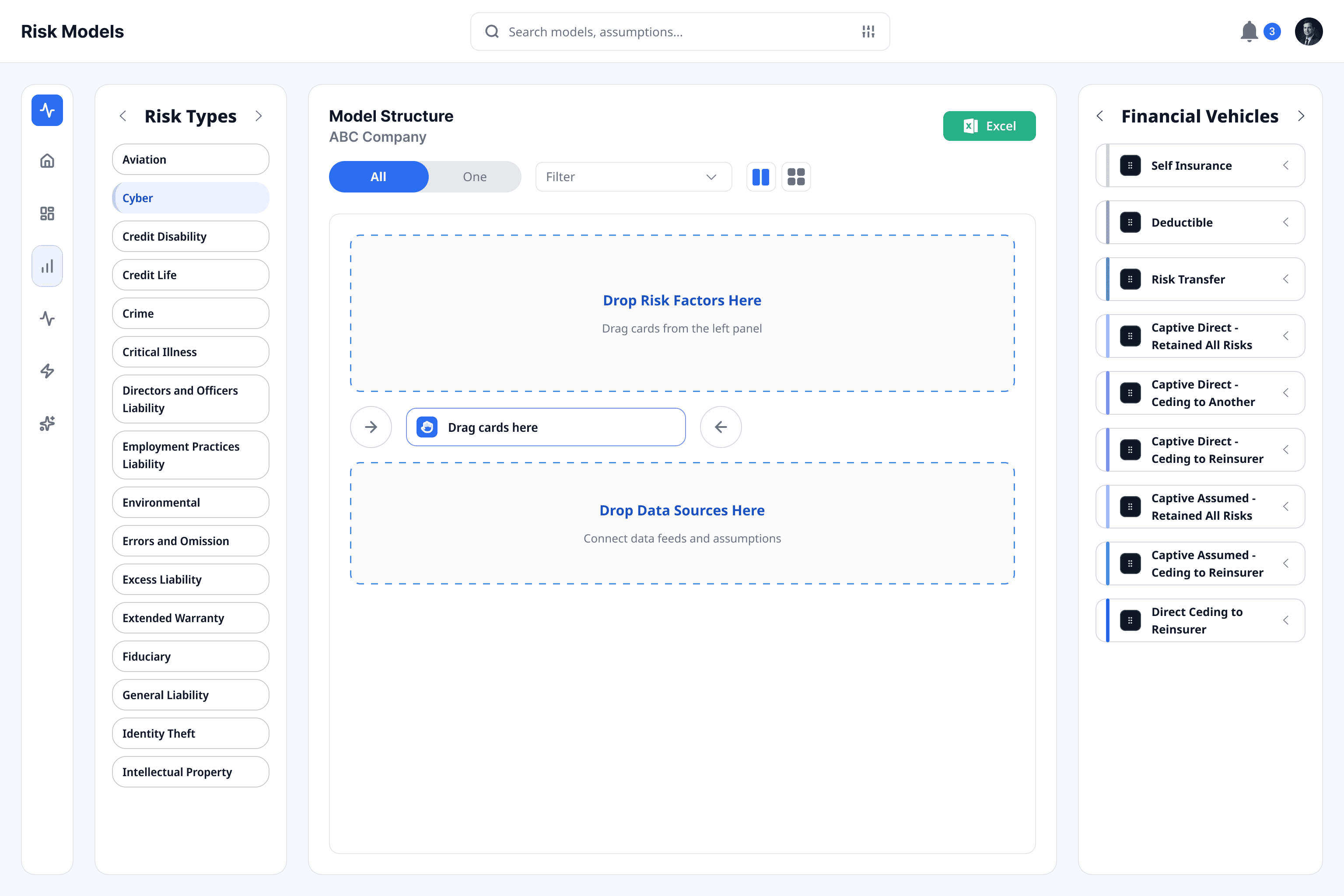

Step-by-step guided model creation
Rather than starting from blank spreadsheets, users begin with structured templates that guide them through selecting risk types, grouping financial vehicles, defining assumptions, and validating logic. This approach shortens onboarding while making advanced modeling accessible to a wider range of specialists.
Interactive model workspace
The workspace brings together risk categories, financial vehicles, and connected model components into a single visual canvas. Real-time editing, drag-and-drop relationships, and contextual validation help users experiment with scenarios before exporting results or sharing models with their teams.
MOBILE MEMBER EXPERIENCE
Insurance, easier to manage anywhere
Insurance products involve complex terminology, multiple stakeholders, and infrequent interactions. I designed a mobile experience that simplifies these moments through clear hierarchy, actionable guidance, and reusable interaction patterns that scale across the member journey.
REVIEW · MANAGE · STAY INFORMED

BUSINESS IMPACT
Turning product concepts into enterprise opportunities
4 Products
Validated in 12 months
Supported commercial validation that resulted in four new product initiatives within twelve months.
Enabled confident investment decisions before development began.
4 Cross-functional team growth
Each validated concept scaled into a dedicated 10+ person product team, expanding delivery capacity across design, engineering, and product.
Startup Hub. Enterprise Innovation
Introduced rapid AI-assisted prototyping that enabled consulting teams to explore product opportunities with startup-like speed while maintaining enterprise quality.
By introducing AI-assisted rapid prototyping into the product discovery process, I helped transform early business concepts into compelling enterprise products that stakeholders could evaluate before development. The approach accelerated commercial validation, supported new client engagements, expanded cross-functional delivery teams, and demonstrated how startup-style innovation can thrive within a global consulting organization.
Enabled confident investment decisions before development began.
NEXT PROJECT / 02
Designing clarity into complex clinical operations
Designing decision-ready workflows for complex clinical research operations and millions of users.